
Intergovernmental Panel on Climate Change:
Fifth Assesment Report; Working Group One:
Chapter 13: Sea Level Change
Chapter Summary and Implications
13.5: Projections of Global Mean Sea Level Rise
The projections of Global Mean Sea Level Rise (GMSLR) are the product of the process-based model ensembles compared to observation in section 13.3 and analyzed for component contribution in section 13.4. In this section, results are reported for the above models and compared to results from Semi Empirical Models (SEMs) for both short and long term projections.
Process-Based Projections for the 21st Century
Based on the results from 21 model runs from the Coupled Model Intercomparison Project Phase 5 (CMIP5) Atmosphere-Ocean Global Climate Models (AOGCMs), process based models incorporated surface air temperature and thermal expansion projections to calculate future GMSLR contributions. These projections do not include forcing from volcanic events which are uncertain in the future and only account for a maximum of ~10 mm GMSLR during the 21st century (aerosols from volcanic eruptions cool the atmosphere, leading to less sea level change due to thermal expansion). The likely range of GMSLR for each RCP scenario is the sum of all the projected contributors and their uncertainties. By the middle of the 21st century, GMSLR is about 0.5 m for all RCP scenarios (Figure 13.10-11). By 2100 ~0.63 m is projected for RCP 8.5 while only 0.4 m is projected for RCP 2.6. Over the next century, in all scenarios, thermal expansion is predicted to be the largest contributor (30-55%) followed by glaciers (15-35%). Over the short term (21st century) Greenland and Antarctic Ice Sheets contribute significantly less, followed by a small contribution from changes in land water storage (Figure 13.10-11).


Figure 13.10-11: A) Process-based model projections of cumulative GMSLR and its contributors in 2081-2100 relative to 1986-2005. Shaded boxes of GIS and AIS show the contribution of just rapid dynamics. B) Time-dependednt projections of total GMSLR and its contibutors over the same time period.
A
B
Semi-Empirical Projections for the 21st Century
Unlike the CMIP5 AOGCMs, which calculate GMSL change based on the sum of the individual physical contributors, Semi-Empirical Models (SEMs) treat GMSL change as a part of the response of the entire climate system. Using the dynamics and thermodynamics of the climate system based on the physical relationships of the different components derived from observational time series, SEMs can project GMSLR as part of an integrated system. Unfortunately SEMs currently have two major issues that either force them to over- or underestimate future GMSLR. First, linear scaling of the rate of future ocean warming by depth tends to cause an overestimation of GMSLR (the gradient of temperature change with depth is likely not linear into the furture). Secondly, glacier sensitivity will decrease in the future as the size of melt areas relative total glacier volume increases. However, as warming continues, high latitude glaciers that currently have negligible melt rates will begin to shrink. These two factors, among others, leave lingering uncertainty in SEM projections, which makes the AOGCM models our most accurate simulate of future GMSLR to date.
Long-term Scenarios
Projections beyond 2100 are more uncertain due to a lack of information and less confidence in the model physics over longer time scales. Nonetheless, important conclusions can be extrapolated from what information and model predictions are available, not only about future conditions, but also on the validity of modeling long-term climate with current model setups. In order to do this, paleo simulations are combined with paleo data to validate models beyond 2100. These projections are separated into three categories based on CO2 emissions: a low scenario of 500 ppm, a medium scenario of 500-700 ppm, and a high scenario for concentrations greater than 700 ppm. As Figure 13.13 shows, these long term projections are similar to the projections up to 2100, with thermal expansion accounting for most of all GMSLR in all scenarios. However, we can see that predicted contributions for the glacier and ice sheets increases with rising CO2 concentration.
For multi-millennial time scales, predictions of GMSL change are made by assessing the sea level commitment from each contributing factor given a rising global temperature (Figure 13.14). The most striking difference is found with the non-linear predicted contribution of the GIS due to ice dynamics affecting outflow.

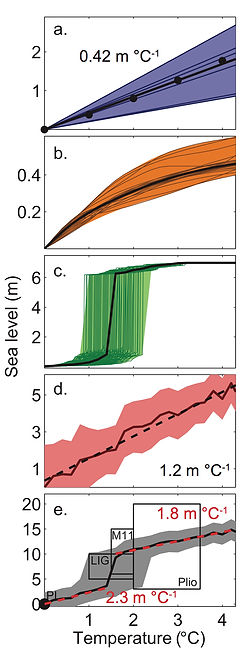
Figure 13.13: Sea level predictions from 2100-2500 grouped by CO2 concentration scenario. Vertical colored bars show entire model spread while horizontal bars show individual model predictions.
Figure 13.14: Multi-millenial predictions of sea level change per degree C for the different contributors to GMSL. (a) Thermal expansion of warming sea water, (b) mountain glaciers, (c) Greenland Ice sheet, (d) Antarctic Ice Sheet, (e) total sea level commitment.